The recent Cuban military maneuvers and displays of weaponry aim to project an image of resilience against a potential aggression from the United States, but they also highlight the profound deterioration of the regime's Revolutionary Armed Forces (FAR), according to a an analysis published by CNN on Wednesday.
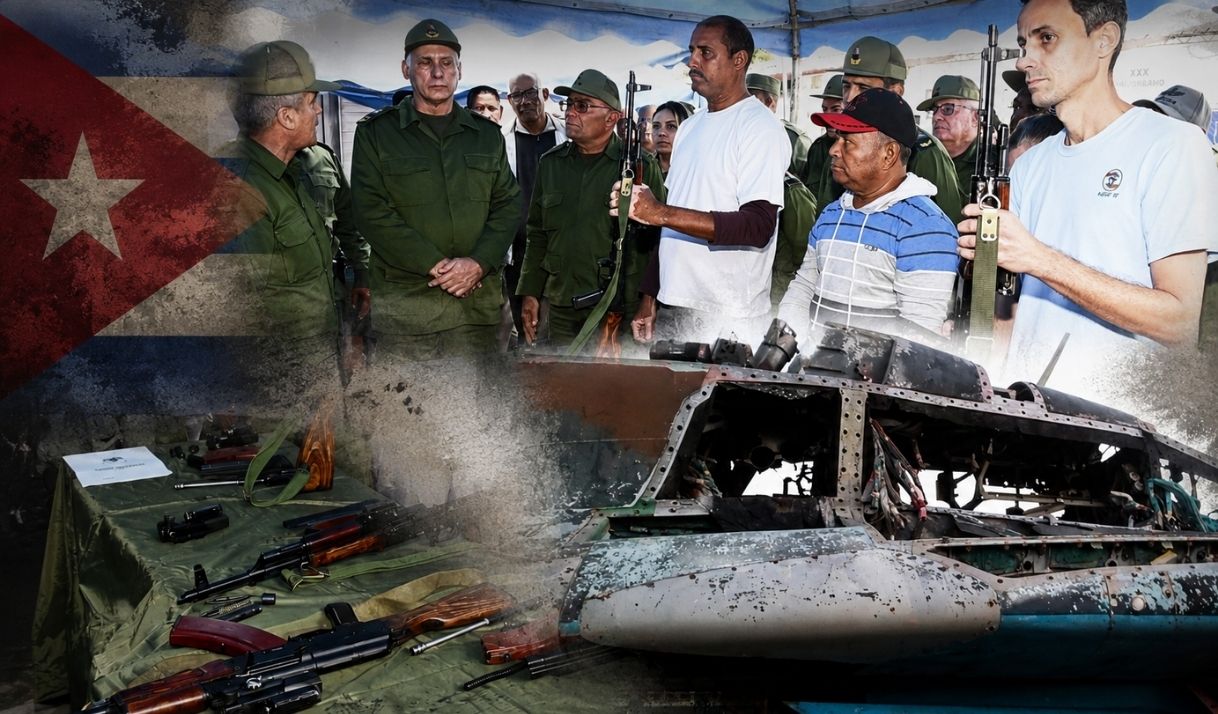
Hundreds of videos and images released in recent months by the Armed Forces and official Cuban media depict a diminished military force, largely equipped with obsolete Soviet weaponry and vehicles several decades old.
Among the images analyzed by CNN was one from April showing a Soviet-made ZU-23 anti-aircraft system being towed by a team of oxen during a local military exercise—a scene that quickly went viral on social media.
Other videos show old military trucks, Russian-made anti-aircraft systems, and special forces units conducting training exercises, such as zip-lining near the coast.
However, for hemispheric security specialist Frank Mora, cited by CNN, these publications do not aim to demonstrate military superiority.
"The videos deliberately showcase aging hardware because they are designed to project defiance, not strength," Mora explained. According to the expert, the goal is to exhibit the resilience of the Cuban people, regardless of the vast difference between the military capabilities of Cuba and those of the United States.
From regional power to an aging army
According to official figures, the FAR reached their peak capacity in the early 1990s, when they had over 235,000 troops and operated relatively new weaponry from the Soviet Union. Following the collapse of the Soviet bloc, the number of active military personnel fell to around 50,000, while much of their equipment became obsolete.
Luis Domínguez, a researcher from the Foundation for Human Rights in Cuba told ADN Cuba that the decline in Cuba's military capabilities is directly related to the end of Soviet support.
"Cuba never had, never bought anything. All the weaponry that Cuba received was given for free by the Soviet Union. The Cuban economy never supported the military it had before," Dominguez said.
"Soviet support extended far beyond the delivery of weapons. It also covered the maintenance of Cuba's entire military infrastructure," Domínguez said. After the collapse of the Soviet Union, Cuba lost not only its primary source of arms but also the steady flow of spare parts, replacement engines, maintenance services, and military training. "All of that was provided free of charge," he explained.
Cuba reached the peak of its military strength following the end of the Angola war, when large numbers of MiG-23 fighter jets, helicopters, tanks, and artillery systems were returned to the island, he added.
But, he argued, the regime never possessed the economic capacity to sustain such a force on its own. "Repairing a single MiG-29 engine costs millions of dollars. After the collapse of the Soviet Union, Cuba simply had no way to maintain that arsenal," he said. While Havana later received limited military assistance from China and North Korea, Domínguez said it was nowhere near enough to replace the scale of Soviet support.
"No MiG is flying anymore"
CNN also highlighted the deterioration of Cuba's Air Force. According to the network's analysis of official military footage, Soviet-designed Mi-17 helicopters are now among the few aircraft that regularly appear in public exercises and official events, while the MiG fighter jets that once symbolized Cuba's Cold War air power have virtually disappeared from view. Analysts interviewed by CNN attributed the decline to decades of shortages of fuel, spare parts, and maintenance, which have left much of the aging fleet unable to operate.
However, Mr. Domínguez offered an even bleaker assessment of the current state of Cuba's Air Force.
"The current situation is terrible. There isn't a single MiG flying, and I say that based on information I receive through the Military Aviation network," he said.
According to Domínguez, many of the aircraft remain stored in hardened underground shelters at San Antonio de los Baños Air Base but are no longer operational.
"Many of those planes have been completely stripped for parts. Even the MiG-29 that shot down the Brothers to the Rescue aircraft has been completely destroyed," he said.
Satellite imagery has also documented the deterioration of aircraft stored at the base, reinforcing assessments that much of Cuba's Soviet-era fleet has fallen into disrepair. The last significant delivery of modern military equipment to Cuba arrived in 1990, just before the collapse of the Soviet Union, after which the island largely lost access to the resources needed to maintain its arsenal, he explained.
"No MiG is flying; they have some training aircraft that fly occasionally. They do have drones, but commercial ones that only serve to observe what is in front of them," he said.
Domínguez estimates that only two air bases in western Cuba—San Antonio de los Baños and Playa Baracoa—remain operational. According to his assessment, most of the island's other military airfields were closed or abandoned during the 1990s as the regime struggled to maintain its aging Soviet-era infrastructure.
Although the Cuban government insists it poses no threat to the United States while maintaining that it would respond to any attack, it has stepped up military exercises in recent months. The Bastión maneuvers and preparations for the so-called "War of All the People" have been accompanied by an extensive propaganda campaign across state media and official social media accounts.
In Domínguez's view, however, these demonstrations are intended more to project strength than to showcase real military capability.
"These exercises are primarily political. They are designed to send a message of resistance and readiness, but they do not reflect the actual operational condition of Cuba's armed forces," he said.
Although Cuba maintains some anti-aircraft defense systems and retains the ability to develop an asymmetric war strategy, analysts agree that the FAR would stand no chance of sustaining a conventional confrontation against the technological, air, and naval power of the United States, whose military superiority is widely recognized by strategic studies centers and former U.S. Defense officials.
"Cuba today has nothing to defend itself with. The only thing it has are the lies it can use to try to stop an American invasion if they think it is going to happen. All they have left is intimidation outward and inward to continue deceiving the Cuban people and prevent them from taking action," he concluded.