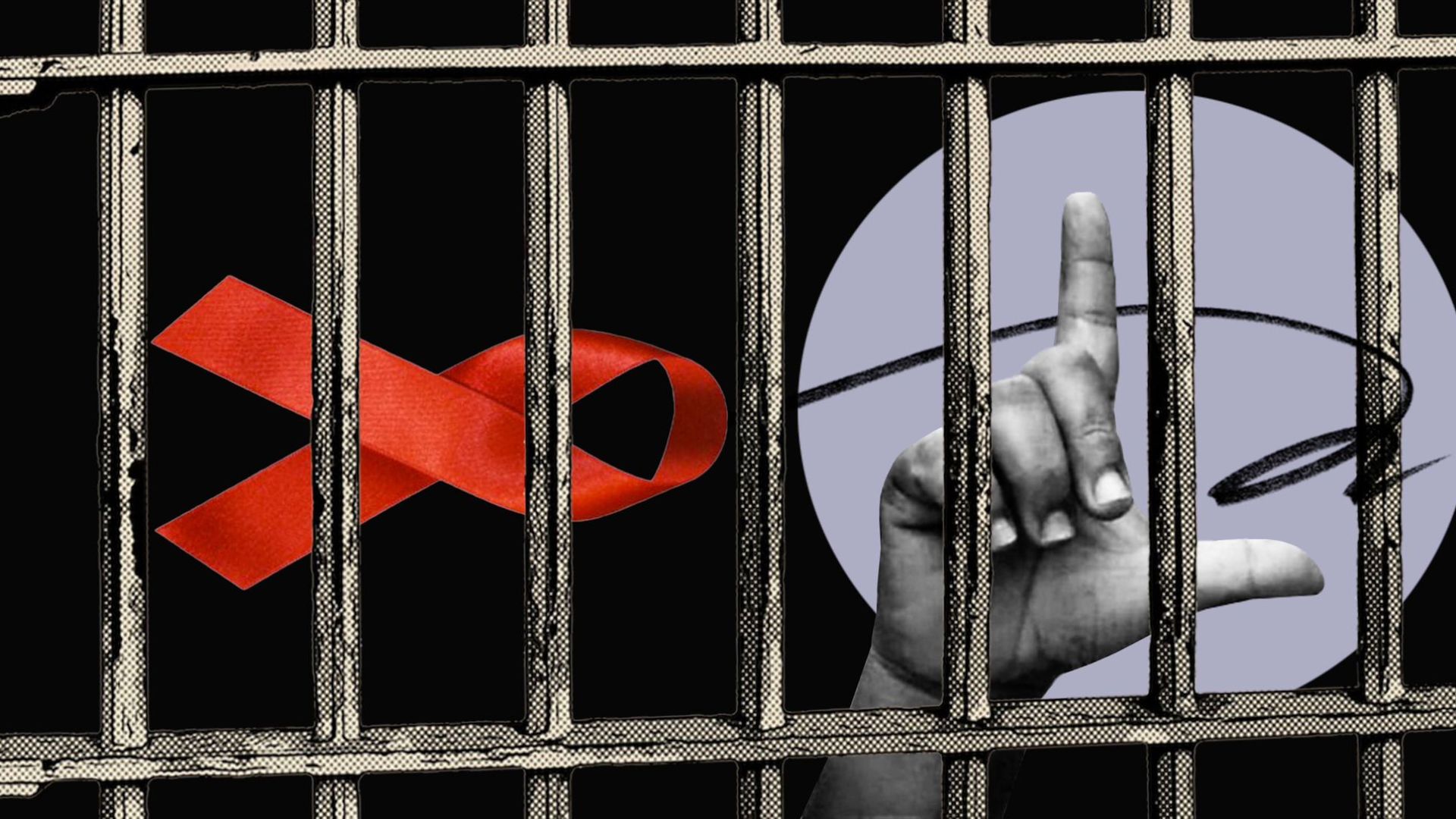
On the occasion of World AIDS Day this December 1, the situation of people living with this disease
in Cuban prisons remains a major concern.Although the regime boasts ambitious public health goals in the fight against HIV within the general
population, the reality is completely different. Specifically, incarcerated individuals face alarming conditions, with constant reports of abuse, inadequate medical care, poor nutrition, and deficiencies in the supply of essential medications.It is important to clarify that Cuba's Penal Execution Regulation acknowledges that there
are 'special' prisons for individuals with HIV/AIDS in the country. Some of these penal institutions are located in San José de Las Lajas, Mayabeque; Santa Clara, Villa Clara; El Caguayo, Santiago de Cuba; and in Holguín, according to documentation from the organization Justicia 11J. target="_blank">documented.However, in several of these prisons, such as the so-called Cuba-Panamá in Mayabeque, numerous reports
of abuse against inmates with HIV have emerged, who suffer not only from the lack of specialized medical attention but also from shortages of food and basic medications.Ana María García, mother of political prisoner Brenda Díaz, an HIV patient confined in Cuba-Pan
amá, told ADN Cuba that the food in the prison is "terrible" and that antiretrovirals are the only medications provided to the inmates, without any medical follow-up. García added that "many inmates have died due to lack of attention" in that prison.Regarding Díaz, she stated that "she has chronic gastritis, HIV, and has kidney problems.
>This prison does not meet the necessary requirements to care for people with HIV.”For her part, Josefa Oramas, mother of Yilian Oramas García, another political prisoner with HIV
, denounced the lack of medical attention in the same prison and the poor nutrition. "My daughter has chronic diabetes and has been in crisis due to lack of food and medications," she explained. At times, she has to send antiretrovirals to her daughter in prison, she confirmed to ADN Cuba.Similarly, Maritza García Rodríguez, aunt of political prisoner of 11J Daysi Rodríguez Alonso,
reported that the young woman is starving in Cuba-Panamá and has been a victim of medical negligence. "She was operated on for a NIC 3 (high-grade cervical intraepithelial neoplasia), a fibroid, and a cyst, and the stitches were removed a year later (...) She still has an open wound and they have never done anything for her."Currently, the political prisoner has bruises on her body and the cause is unknown because she has
not received specialized medical care.Abuse, negligence, and deaths in prison
The lack of health care for prisoners with HIV is not only a question of deficiencies in treatment
but also of abuse by penitentiary authorities. Activist and former political prisoner Ángel Moya highlighted that not only people with HIV, but also the rest of the prisoners, suffer constant abuse in Cuban prisons.Moya specifically referred to reports of mistreatment and poor nutrition in the Cuba-Panamá prison
, where many inmates with HIV live in unsanitary conditions and are victims of physical assaults by officials. He recalled that on several occasions the political prisoner and Dama de Blanco Jacqueline Heredia, confined there, target="_blank">has denounced this situation. He even pointed out the theft of medications by prison staff.A concerning case was that of Luis Carlos Amador, who
target="_blank">died in January 2024 in the same prison after suffering an epileptic seizure and not receiving timely medical assistance. The complaint made by Moya at that time asserted that the guards did not help him when he needed it, which ultimately led to his death.In this regard, the organization Archivo Cuba
target="_blank">reported three deaths of people with HIV under state custody between 2012 and 2022 in the country, which occurred in prisons in Havana, Pinar del Río, and Mayabeque.Moreover, other reports
, such as that of Heriberto Téllez Reynosa from the prison El Caguayo in Santiago de Cuba, reveal severe shortages of food and medications. Téllez recounted in the previous February that inmates with HIV barely receive two or three hours of sunlight a week and that the conditions to withstand the cold are minimal.Camila Rodríguez, director of the Cuban Prison Documentation Center (CDPC), warned that although
some detention centers are exclusively for individuals with HIV, these prisons still face the same problems as the rest of the prisons in the country. "Centers have been created where the incarcerated population with HIV has been isolated, but in the long run, this specific system of separation implemented by the regime has only further isolated these individuals, and the separation has not translated into guarantees for their security and well-being,” she added.The CDPC has recorded complaints related to the health status of at least 15 individuals who have
lived with HIV and have been incarcerated. Additionally, they have on their records four individuals who live with HIV and are political prisoners."The prisons where individuals living with HIV are held face all and every one of the neglect and
deficiencies that the rest of the prisons in the country encounter," Rodríguez noted.Funding from international organizations. What does the regime do with the money?
According to data obtained from the review of documents from the Global Fund to Fight AIDS, Tuberculosis
and Malaria, in its National Strategic Plan (PEN) for the period 2024-2026, Cuba has committed to ensuring that 95% of diagnosed individuals receive antiretroviral treatment (ART) each year>. Furthermore, national goals include that a significant percentage of the population with HIV estimated by UNAIDS be diagnosed and receive ART.According to the information requested by the Cuban side, this international support is focused on
34 priority municipalities, where the most severe HIV cases are concentrated, particularly among men who have sex with men (MSM). Official data published on November 26, 2024, on the website of the Ministry of Public Health (MINSAP) demonstrate that the regime receives funds from both organizations. Nonetheless, reports of abuse and lack of proper treatment for individuals living with HIV continue in the prisons.Manuel Romero Placeres, head of the National Program for the Control and Prevention of HIV in Cuba
, recalled that the PrEP treatment was introduced in Cuba in 2019 as part of a pilot project >with technical and financial support from the Pan American Health Organization, UNDP, and the Global Fund.Years later, in April 2024, they implemented the program "Expansion of differentiated HIV services
in Cuba," with support from these three organizations, covering 36 polyclinics and 7 community spaces in all Cuban provinces and the special municipality Isla de la Juventud.While Cuba has committed to meeting UNAIDS' global goals, such as the target 95-95-95 (95% diagnosis
, 95% treatment, 95% viral suppression), the reality in the country's prisons and outside them is that many individuals with HIV do not have access to the basic care necessary for their survival.ADN Cuba consulted with the Directorate of Penitentiary Establishments, the Global Fund, UNDP
, and MINSAP for a comment on this matter but has not received a response.