An internal planning document distributed by the National Network on Cuba (NNOC) since June 2026, which ADN Cuba accessed, instructs organizers across the United States to prepare protests in front of offices of the Immigration and Customs Enforcement (ICE), military bases, recruitment centers, and federal institutions in the event of military confrontation between Washington and Havana.
The document, titled National Rapid Response Plan, lays out a coordinated strategy to activate demonstrations within 24 hours of a potential U.S. military attack on Cuba's dictatorship or an imminent military escalation. More than a general call to protest, it identifies specific protest targets, establishes a nationwide response timeline, and provides operational guidance for synchronizing actions across affiliated organizations.
The plan calls for local actions to target “one or more” of three categories, depending on the conditions of each city:
Federal institutions: federal buildings, courthouses, post offices
- U.S. military bases / recruitment offices
- Detention centers & ICE field offices: connects Cuba solidarity to anti-ICE/immigrant defense work happening nationwide.
The document not only identifies ICE offices as one of the main protest targets but also explicitly explains why. According to the plan, demonstrations at these facilities would allow to "connect Cuba solidarity to anti-ICE/immigrant defense work happening nationwide."
This would not be the first time that organizations from the so-called "solidarity with Cuba" movement participate in such mobilizations. The No Kings protests, for example, is listed in the 2026 activity calendar of the Seattle Cuba Friendship Committee, one of the organizations linked to this network.
The National Network on Cuba (NNOC), a coalition based in the United States that groups more than 70 organizations, has documented ties with the Cuban Institute of Friendship with the Peoples (ICAP), a Cuban state body sanctioned by the United States in June 2026.
On July 1, Secretary of State Marco Rubio characterized that organization as the main "influence and intelligence front" of the Cuban regime and warned that those who maintain ties or conduct transactions with it could face sanctions, legal proceedings, or deportation.
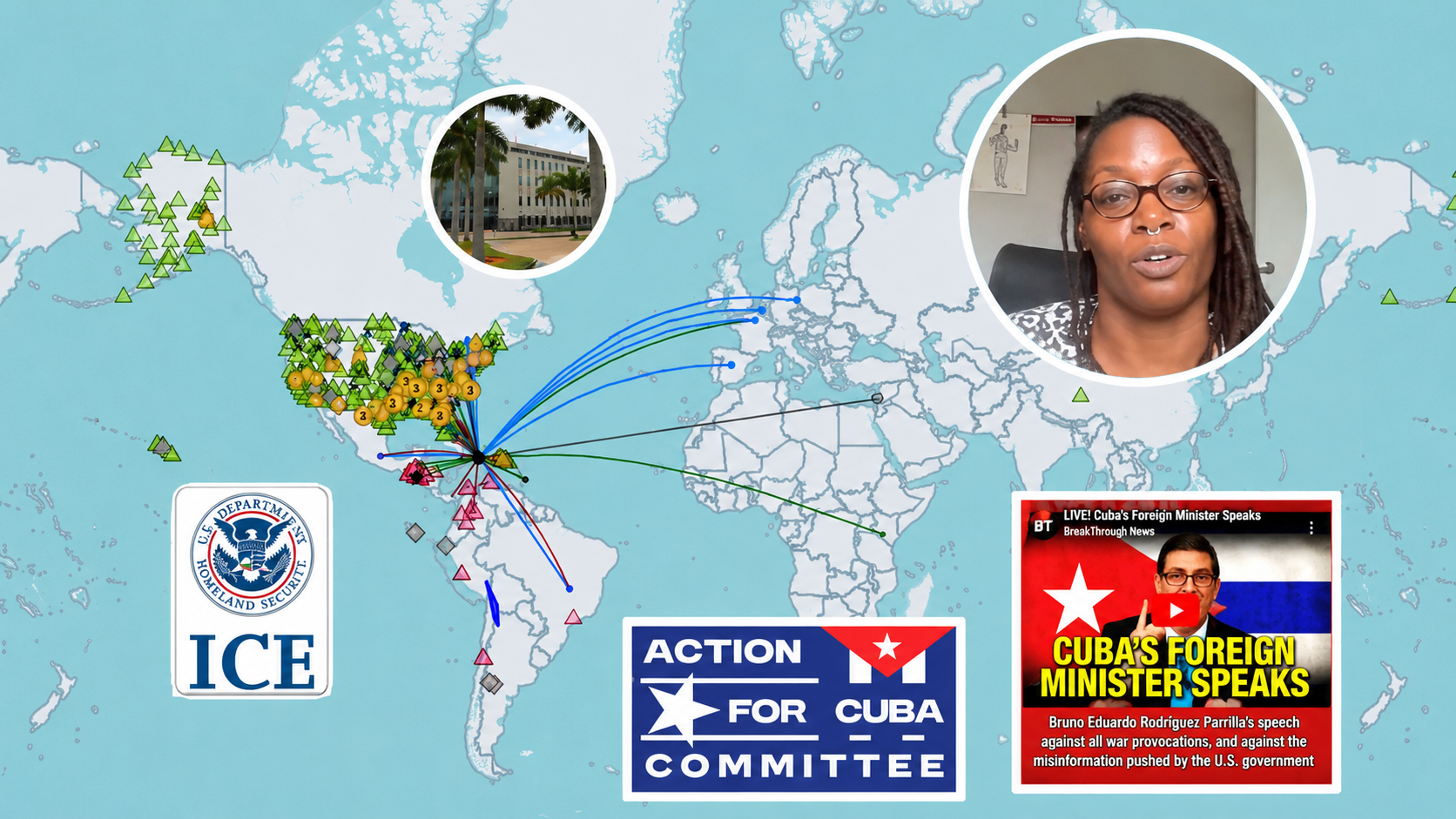
The document also recommends that organizers use a military facility locator developed by Black Alliance for Peace to identify bases and other military infrastructure targets in their respective communities.
It also includes a "power mapping" guide, a methodology for organizing aimed at identifying unions, community organizations, and potential allies in each locality to enhance the campaign's mobilization capacity. As an additional objective, the NNOC plan recommends organizing actions in sports stadiums during high-visibility events, in order to maximize the public impact of the protests.
The strategy was publicly promoted by Onyesonwu Chatoyer, co-chair of the National Network on Cuba (NNOC), a member of the National Coordinating Committee of the Venceremos Brigade and a member of the Central Committee of the All-African People's Revolutionary Party (A-APRP).
In a video broadcast by the organization on June 12, Chatoyer stated that the network had approved the "national rapid response plan" during its spring meeting held in late May. "Across the United States, NNOC organizations are organizing rapid responses in the event of a military attack by the United States on Cuba," she noted.
Beyond defining the places of protest, the plan establishes a uniform timeline for the entire country. If a military action occurs before 3:00 p.m. (Eastern Time), demonstrations would begin that same day at 6:00 p.m. local time in each city. If the triggering incident occurs after that time, protests would be held the following day.
The objective, according to the document, is to facilitate simultaneous mobilization across multiple time zones.
The rapid response plan does not appear in isolation. It is part of the No War on Cuba Campaign Toolkit, a package of materials designed to coordinate communication, political training, and mobilization among organizations affiliated with the National Network on Cuba (NNOC).
The toolkit includes template resolutions for city councils and unions, signature gathering campaigns, graphics materials, "power mapping" guides to identify local allies, social media resources, and political training content.
It also promotes international days of action and support campaigns for Cuba. The materials present a narrative aligned with the official position of the Cuban government.
They include references to the Cuban Institute of Friendship with the Peoples (ICAP), videos from Foreign Minister Bruno Rodríguez Parrilla, and campaigns to promote the lifting of U.S. sanctions and the exclusion of Cuba from the list of state sponsors of terrorism. The call coincides with the anniversary of the 11J protests
While human rights organizations commemorate the fifth anniversary of the protests on July 11, 2021—the largest anti-government demonstrations recorded in Cuba since 1959 and after which more than a thousand people remain imprisoned for political reasons, according to human rights organizations—several groups affiliated with the National Network on Cuba (NNOC) are promoting activities in favor of the Cuban regime for the same date.
These include the event “No War on Cuba,” organized by the Bay Area Cuba Solidarity Network in Berkeley, California, with the announced participation of Cuba’s deputy ambassador to the United States, Tanieris Diéguez, and the embassy’s second secretary, Gabriela González. The call is also promoted by the anti-imperialism committee of the East Bay Democratic Socialists of America (DSA) chapter.
Actions promoted by the National Network on Cuba (NNOC) occur in a context marked by the ongoing repression on the island. According to the Cuban Observatory of Human Rights (OCDH), the Cuban regime committed 1,949 repressive actions against citizens during the first half of 2026, while over 1,000 political prisoners remain incarcerated, according to human rights organizations.
In this context, a survey published in April by the Miami Herald revealed that 79% of Cubans and Cuban-Americans surveyed in South Florida supported some form of U.S. military intervention on the island. Of those, 36% supported an action to overthrow the communist regime, while another 38% favored an intervention aimed at both regime change and addressing the humanitarian crisis.
Together, the "Rapid Response" plan and the No War on Cuba Campaign Toolkit offer a rare glimpse into the organizational structure that the NNOC aims to activate to support the Cuban regime's position in the event of a potential U.S. military intervention in Cuba. The documents illustrate how the network seeks to coordinate protests, communication campaigns, coalition building, and synchronized actions in various U.S. cities.